Flora and Fauna

The Otway Fly Tree Top Adventures is home to a wide range of native flora and fauna.

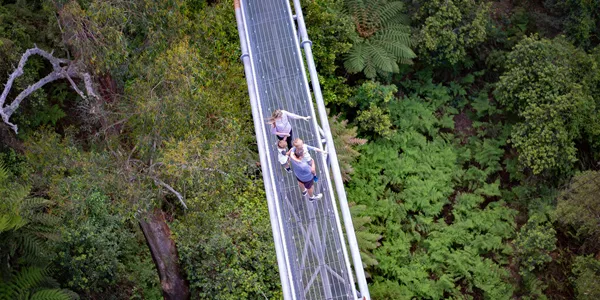
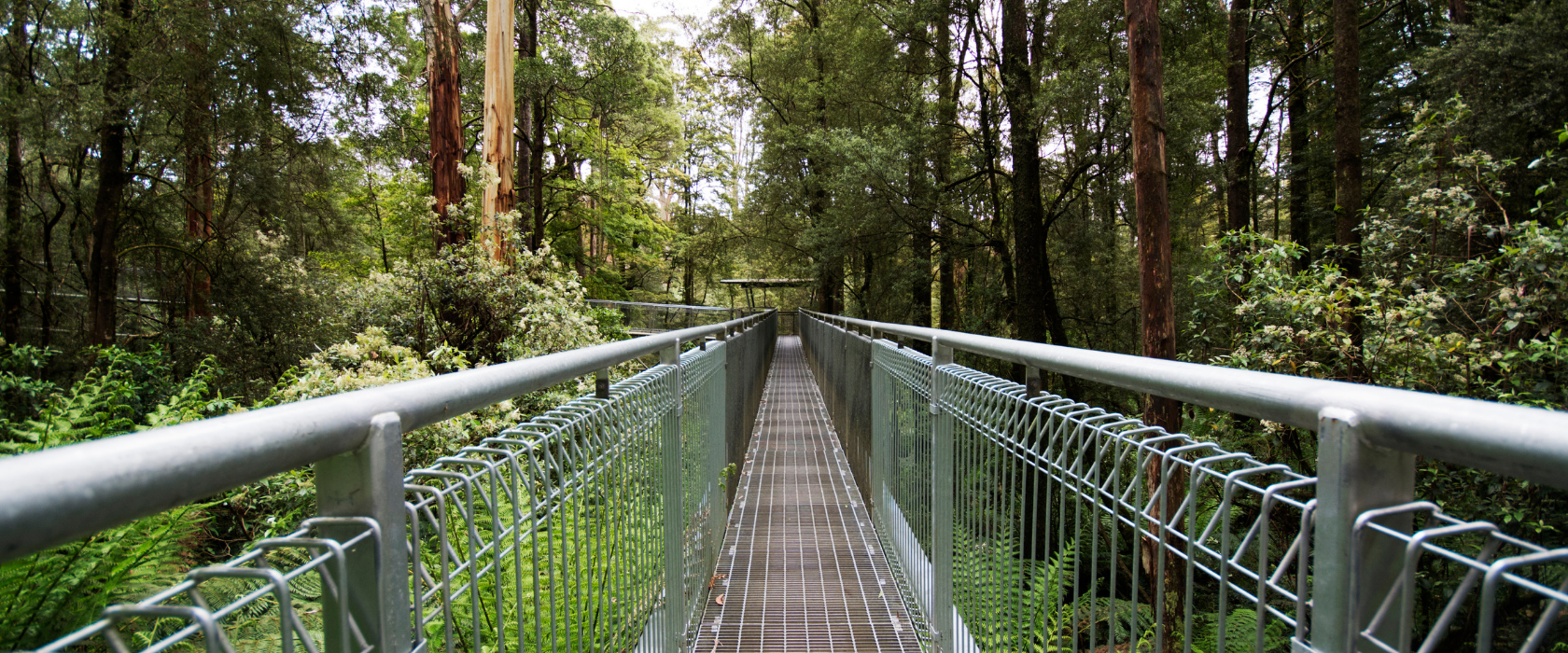
This is the ultimate flora experience immersed within the treetop canopy of the exquisitely beautiful, ancient Beech Myrtle forest.

Walk in the tranquil serenity of the endless expanse of fern covered forest floor beside Young’s Creek. See “Big Boy”, the giant of the forest, 5 metres in diameter at its base and towering 65 metres in height. This inspirational valley remains one of the finest pockets of forest in the Otway Range.

The Otways is also abound with a rich diversity of birdlife.

See them as you have never seen them before amid the magnificent old growth forest of the Otway Ranges. The brilliant red flash of the Crimson Rosella, the raucous cry of the Yellow-tailed Black Cockatoo, the enigmatic Spotted Quoll and the endearingly cute Pygmy Possum are there to be spotted by the keen observer.

Some of the unusual species only to be found in the region include the Otway Stonefly Eusthenia nothofagi and watch out for the distinctive, endemic and carnivorous Otway Black Snail.

Interpretive signs along the walk provide useful information on the local flora and fauna.

Here’s just a taste of what you might uncover along the walk;

Mountain Ash (Eucalyptus regnans)

The world’s tallest flowering plant, it has been known to reach more than 100 metres. No trees of this size remain in the Otways, where the Mountain Ash has been logged and re-seeded for more than 150 years.

The wood is hard, dense and straight-grained – ideal for flooring, wall-panelling and weather-boards. Unlike most eucalypts, fire kills Mountain Ash. However, fire also causes its seeds to regenerate. Each stand of Mountain Ash represents the passage of a bushfire.

The trees reach maturity at about 300 years, and will live far beyond that. To sustain their enormous height, they develop huge buttresses at the base of their trunks.

Around Beech Forest, these buttresses were hollowed out and used in novel ways. One became a stable big enough to house five horses. Another formed the base of a racecourse grandstand, while others became temporary homes for early settlers.

Mountain Ash is an important tree for birds. They take nectar from the blossom, insects from foliage and bark and use hollows in the trees as nesting places.

Myrtle Beech (Nothofagus cunninghamii)

Nothofagus similar to this species were part of the Cretaceous forests when the Otways were formed.

Myrtle Beech is a major part of the rainforest flora, sharing the canopy with Blackwood. It may grow up to 30 metres tall in sheltered gullies and may live for 300 years or more.

As the trees age, the branches become festooned with trailing moss, while other epiphytes grow on the rough-barked trunk.

Fire has no place in rainforest. Any greater frequency than once in 1,000 years can be disastrous. Rainforest can only develop when there is an absence of fire.


Wildlife of Otway Fly Tree Top Adventures

Over 50 species of land mammals including nine exotics have been recorded in the Otway Ranges.

  • Platypus and Short-beaked Echidna: the only egg-laying mammals, or Monotremes, in Australia, are relatively common in the Otway Ranges. Catch a lucky glimpse of our shy resident Platypus as you cross Youngs Creek. Echidnas may be met along any roads through the Otways.
  • Carnivorous marsupials : Eight species of small, carnivorous marsupials have been found in the region, but one of these – the Eastern Quoll or Native Cat – is extinct. The larger, Spot-tailed Quoll or Tiger Cat, remains, but it is rare.
  • Possums: Common Ringtail possums are usually found in the under-storey shrubs. Sugar Gliders and the large Yellow-bellied Gliders use tree-hollows, and Feather-tailed Gliders and Eastern Pygmy-possums (pictured) are also forest dwellers. The Common Brushtail possum is widespread.
  • Pouched-mice: Antechinus and dunnart are the two groups of mammals once referred to as pouched-mice. The Brown Antechinus is by far the most plentiful of the five species that inhabit the Otway Ranges.
  • Bandicoot: Two species of bandicoot live in the Otways. The Southern Brown prefers heathland, while the Long-nosed Bandicoot occurs in wetter country.
  • Wombat: The Common Wombat is found in high-rainfall forests in eastern Victoria, but did not establish populations in the Otways. Up until the 1950s there was a small colony near Barwon Downs.
  • Koalas: Koalas are found in several parts of the Otways including the Grey River reserve and near the Parker River mouth.
  • Wallaby and Kangaroo: Red-necked Wallaby and Eastern Grey Kangaroo show a habitat preference for the more open woodlands, but the Black Wallaby will be found throughout the ranges.
  • The shy little Long-nosed Potoroo is reasonably plentiful in heathlands and forest.
  • Water Rat: The Water Rat is the largest of the six species of native rodents found in the Otways. Much rarer, the Broad-toothed Rat is one of our most enigmatic mammals. Bush Rats and Swamp Rats are common in the forests. The New Holland Mouse is confined to areas near Anglesea.
  • The Stowaways: There are nine introduced stowaways in the Otways, including the House Mouse, Black Rat, Feral Cat, European Rabbit, Brown Hare and Red Fox.

The Otway Flyers

  • The small and beautiful; the raucous and gawdy; an amazing variety of bird life frequents the Otways.
  • Bassian Thrush: Beautifully camouflaged with speckled brown plumage, the thrush is difficult to see against the fallen beech leaves as it searches for worms and other invertebrates on the forest floor
  • Eastern Yellow Robin: Conspicuous and unafraid of people, the yellow robin is one of the most frequently seen forest birds. Often the first bird to call before sunrise and the last at night  indeed, its scientific name means œpsalm singer of the dawn
  • Crimson Rosella: A flash of crimson and blue is often all you will see as a pair of rosellas fly through the forest. Rosellas feed on the seeds of a range of native plants, including blackwood, and on both native and orchard fruit. A tree hollow is used as a nesting place and up to eight white eggs form the clutch.
  • Powerful Owl: One of the worlds largest owls, it hunts possums, gliders, even young koalas. It is sometimes seen during the day standing on last night’s prey, which it will eat the next night. Owls nest in large hollow trees, raising their brood of up to three young through late winter and spring.
  • White-naped Honeyeater: One of many nectar-feeding species, the black head, olive green wings and black and white under parts are distinctive. It has a soft call that may sound like a child sucking a lolly pop, giving the bird its nickname of sweet-sucker.
  • White-browed Scrubwren: A small, noisy, brown bird of the undergrowth, its agitated chattering is a good warning that a snake is nearby. The nest is an untidy mass of grass and other plant fibre, with an entrance at one side, well hidden in the undergrowth usually close to the ground.
  • White-throated Treecreeper: This is the bird most commonly heard in the forest. Its call is a loud, high-pitched, continuous piping. Treecreepers feed on insects. They nest in tree hollows.
  • Striated Thornbill: Tiny and olive-brown, it is a bird of the canopy where it searches for insects, their larvae and other invertebrates. Its nest is tennis-ball size, made of plant fibre and lined with feathers.
  • Other birds include: kookaburra, various cuckoos, other cockatoos, bowerbird, currawong.

Make the most out of your day

Bush Walking

Bush Walking

The walk commences at the visitor centre,

Read More

Treetop Walk

Treetop Walk

Otway Fly Treetop Walk

The Treetop Walk is a unique attraction which enables visitors to experience a 600

Read More

Cafe

Cafe

Our Café offers gourmet and organic seasonal local produce with both indoor and outdoor dining.

Read More